
Draft — image required.
Tata Consultancy Services reported that its annualised artificial-intelligence revenue reached $3.1 billion in the September 2026 quarter, crossing 10% of company revenue. However, the TCS Q2 AI revenue milestone came alongside constant-currency sequential growth of only 0.5%, the company’s weakest September-quarter performance in three years, according to Reuters.
The result captures the tension facing India’s large information-technology services companies: AI is producing new consulting, modernisation and engineering work while also reducing prices and spending on some traditional labour-intensive services.
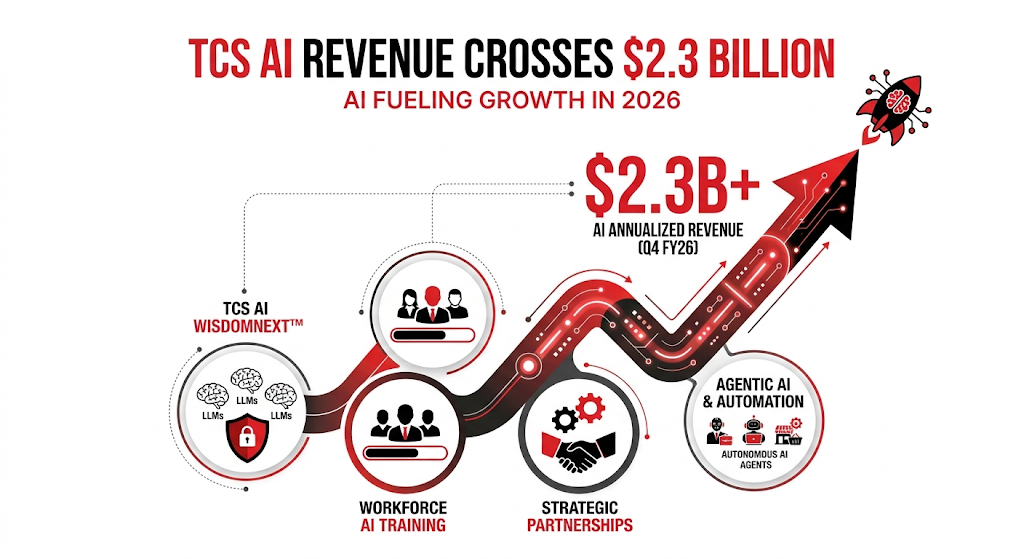
TCS Q2 AI revenue crosses $3.1 billion
TCS said annualised AI revenue rose from $2.6 billion in the June quarter to $3.1 billion in the three months ended September 30. That represents growth of about 19% quarter on quarter and puts AI-related work above one-tenth of overall revenue.
The company’s official release reported quarterly revenue of $7.642 billion, representing 0.2% sequential growth in US-dollar terms and 0.5% growth in constant currency. International revenue grew 1.2% sequentially in constant currency, led by manufacturing, technology and services, and banking and financial services.
TCS reported total contract value of $9.6 billion, slightly above $9.5 billion in the preceding quarter but below the $10 billion recorded a year earlier, Reuters said. The measure represents the value of contracts signed during the period rather than revenue already earned.
Profit rises while core demand remains cautious
Consolidated revenue rose 11.2% year on year to ₹73,188 crore, marginally above the average analyst estimate compiled by LSEG. Quarterly net profit increased 15% to ₹13,884 crore and also exceeded the analysts’ mean forecast cited by Reuters.
TCS reported an operating margin of 24% and a net margin of 19%. The board declared an interim dividend of ₹12 per share, with October 14 set as the record date and payment scheduled for October 30.
Despite the year-on-year profit increase, management said discretionary technology programmes without clear near-term value remained under scrutiny. Financial Express reported that broader deal flow stayed muted even as demand for AI-native services, AI-led transformation and cybersecurity continued to grow.
AI creates demand and pricing pressure
AI adoption is changing the commercial model of India’s $315-billion IT services industry. Automation can reduce the number of billable hours required for existing work, creating pressure on legacy revenue and pricing. At the same time, companies are winning projects to build AI systems, modernise enterprise software and manage governance and security.
Reuters cited analysts who warned that rising AI revenue should be viewed alongside contraction in traditional services. That means the AI headline does not automatically translate into faster overall company growth.
TCS has responded by expanding AI training and specialist deployment teams. The company reported 17.1 million employee learning hours during the quarter, up 17% sequentially. Its workforce reached 598,056, while trailing 12-month attrition in IT services stood at 13.3%.
What the TCS result signals for Indian IT
TCS is the first large Indian IT company to report results in the current earnings cycle. Investors will compare its cautious demand commentary with upcoming disclosures from Infosys, HCLTech, Wipro and Tech Mahindra.
Key indicators include constant-currency growth, contract bookings, operating margins and the share of revenue generated by AI services. The central question is whether new AI demand can grow quickly enough to offset lower prices and reduced spending on conventional outsourcing.
The ₹73,188 crore revenue figure used here comes from the TCS release and Reuters. Some reports cited a different headline revenue measure, so figures should be compared only when they use the same accounting basis.
Google Trends’ public snapshot did not expose verifiable India-specific volume for the selected keyword. The story was selected for same-day corporate and technology prominence; no search-volume ranking is claimed.

