
Draft — image required.
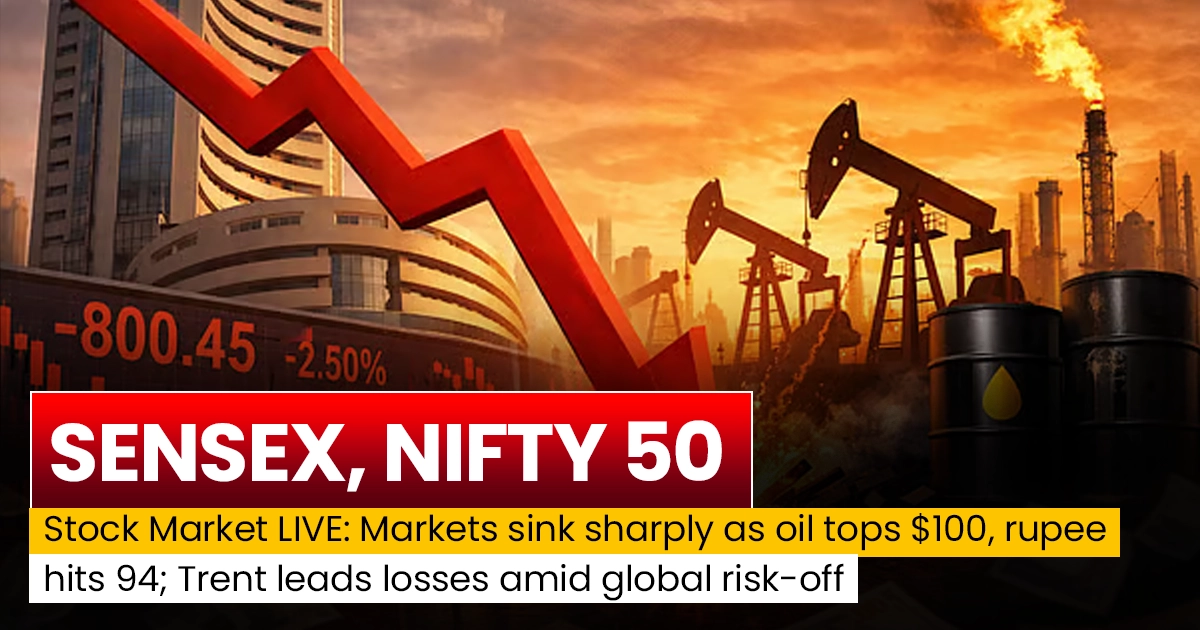
Indian equities suffered a broad sell-off on Thursday, October 8, with the BSE Sensex closing at its lowest level in 32 months and the NSE Nifty 50 at its lowest close in 18 months. The Sensex Nifty market fall followed higher crude-oil prices, rising global bond yields, persistent foreign selling and the Reserve Bank of India’s shift toward tighter monetary policy.
The Sensex fell 1,045.46 points, or about 1.44%, to close at 71,593.24. The Nifty 50 lost 371.25 points, or 1.64%, to finish at 22,231.80. Financial Express reported that the Nifty touched 22,179.90 during the session.
Sensex Nifty market fall reaches new lows
The decline was not limited to a few heavyweight shares. Reuters reported that all 16 major sectoral indices finished lower, while small- and mid-cap benchmarks fell by more than 2%. Economic Times market data showed the Nifty Midcap 50 down 2.71% and the Nifty Smallcap 50 down 2.48%.
Market breadth was sharply negative. The Economic Times reported 2,645 declining securities on the NSE against 693 advances, with 117 unchanged. Among the Nifty 50 companies, Financial Express said only Infosys, Tech Mahindra and Axis Bank ended with small gains.
Adani Enterprises was among the largest Nifty losers, falling 5.4%, while JSW Steel and ITC declined by more than 4%, according to Financial Express. Metals, real estate and oil-and-gas shares were among the weakest sectoral groups.
Oil, rates and foreign selling pressure stocks
Several pressures converged during the session. Oil prices rose as attacks on shipping in the Gulf and the Strait of Hormuz renewed concern about supplies from the Middle East. Higher crude prices are a particular risk for India because they can increase the import bill, put pressure on the rupee and add to inflation.
The sell-off also followed the RBI’s decision a day earlier to raise the repo rate by 25 basis points to 5.50% and change its policy stance from “neutral” to “calibrated tightening.” The decision itself was widely anticipated, but the new stance signalled that further rate increases remain possible if inflation stays elevated.
Higher global bond yields added another headwind by increasing the relative appeal of fixed-income assets and tightening financial conditions. The Economic Times also cited weak global markets and concern about further US Federal Reserve increases.
Foreign portfolio investors have continued to reduce exposure to Indian shares. Reuters reported net sales of ₹469.9 billion, or about $4.86 billion, over nine trading days, taking foreign equity outflows for 2026 to a record $30.4 billion. Domestic institutional buying has partly offset foreign sales on some sessions but has not prevented the broader decline.
Indian equities lag global peers
The Nifty 50 has lost nearly 15% in 2026, Reuters reported, while the MSCI emerging-markets index has gained about 23%, helped by flows into artificial-intelligence-linked stocks. That divergence reflects both global investor preferences and India-specific concerns over oil, inflation, interest rates and the rupee.
The October 8 decline also pushed technical indicators into heavily oversold territory, but that alone does not establish when the market will recover. Prices can remain volatile while investors reassess corporate earnings, foreign flows and the outlook for borrowing costs.
What investors should watch next
Tata Consultancy Services is beginning India’s September-quarter earnings season, giving investors the first major corporate test after the sell-off. Results and management guidance from large companies will help determine whether profit growth can offset the pressure from tighter financial conditions.
Other near-term indicators include crude-oil prices, the rupee, US bond yields, foreign institutional flows and how banks transmit the RBI increase to lending and deposit rates. Investors should distinguish these verified market-close figures from predictions about future index levels. This article provides news and context, not investment advice.
Google Trends’ public snapshot did not provide verifiable India-specific volume for the selected keyword, so the story is ranked by same-day editorial and market prominence rather than a claimed search-volume position.

