
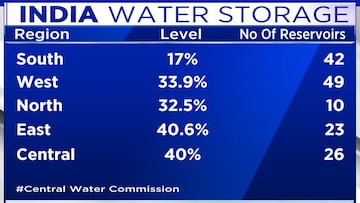
Water held in 178 monitored reservoirs across India has fallen to 70% of their combined live-storage capacity as the southwest monsoon approaches its September 30 conclusion, according to a Central Water Commission report dated September 24.
The latest India reservoir storage level is below the 10-year average of 76.62% for the corresponding period and below the 79% recorded in 2025. The figures point to sharply uneven water availability ahead of the rabi sowing season.
India reservoir storage falls below its long-term average
The Central Water Commission monitors reservoirs used for drinking-water supply, irrigation, hydropower generation and other purposes. Indian Express reported that the 178 reservoirs were at 70% of capacity, the lowest corresponding level in a decade.
The national figure follows a weak monsoon season. India had received 12% less rainfall than normal through September 28, with June 35.4% below normal and August 16.3% below normal. July was close to normal, while rainfall from September 1–28 remained 5% deficient.
Earlier September data independently reported by Mint and Informist Media already showed national storage near 71% and below both last year’s level and the long-term norm. The September 24 update therefore continues an established decline rather than representing a sudden one-day fall.
Southern and northern reservoirs face the sharpest gaps
Southern India recorded the weakest regional position. Reservoirs across Andhra Pradesh, Telangana, Karnataka, Kerala and Tamil Nadu held 27.926 billion cubic metres, equivalent to 50% of capacity. The comparable level a year earlier was 87.25%.
The region’s rainfall was 23% below normal through September 28. This matters for irrigation and urban water planning because replenishment opportunities typically narrow once the southwest monsoon withdraws.
Northern India also showed a major year-on-year decline. Eleven reservoirs across Himachal Pradesh, Punjab and Rajasthan were at 62% of capacity, compared with 92.3% in the corresponding period of 2025.
Reservoirs in the eastern region stood at 73%, while the west and centre retained relatively stronger levels. Fifty-eight dams across Gujarat, Maharashtra and Goa held 84.61% of capacity, and 28 central-region reservoirs held 85.55%. Both readings were nevertheless below their 2025 comparisons.
Why the storage numbers matter
Reservoir conditions influence winter-crop irrigation, hydropower output and drinking-water security. Lower storage in the south and north increases the importance of careful allocation if the post-monsoon period remains dry.
The figures should not be read as a uniform nationwide shortage. Conditions vary substantially by reservoir and region, and western and central storage remains materially stronger than in the south. The data instead shows that the national buffer is smaller than normal and that regional stress is concentrated.
The CWC report coincides with drought declarations in Maharashtra and Karnataka. Any assessment of local water availability should still rely on state authorities and reservoir-specific releases rather than the national percentage alone.
Google Trends India yielded no usable measured search-volume evidence for this subject. The focus keyword reflects the official dataset and its national public-interest significance, not a claimed search ranking.

