
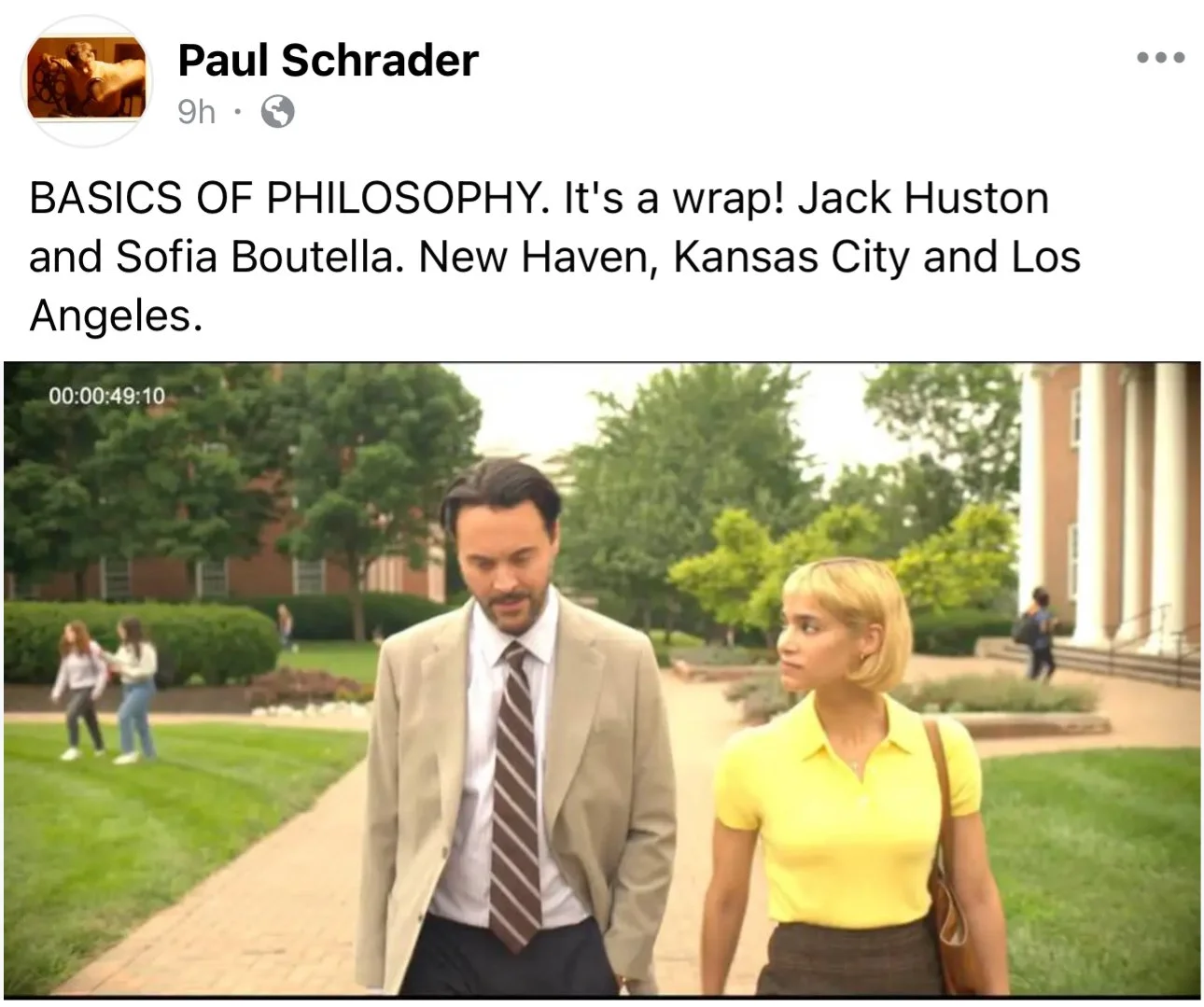
Paul Schrader premiered The Basics of Philosophy at the Venice Film Festival on September 4, 2026, presenting another study of guilt, conscience and the possibility of redemption.
The film screened outside the main competition. La Biennale’s programme listed press and industry screenings followed by an evening public presentation at the Sala Grande.
What The Basics of Philosophy examines
Jack Huston plays a philosophy professor confronting the consequences of a hidden transgression. The official festival synopsis and Schrader’s director statement frame the story around identity, deception and moral responsibility.
Schrader described the film as a continuation of the isolated, reflective protagonists that have shaped his work since Taxi Driver. That connection is thematic rather than a narrative sequel.
Guilt and ordinary wrongdoing
Reuters reported that Huston viewed the film’s wrongdoing as concealed within an apparently ordinary person rather than embodied by a conventional villain. The approach places attention on internal conflict and the architecture of conscience.
Schrader’s upbringing in a Dutch Calvinist environment has frequently informed his interest in sin, predestination and redemption. The new film returns to those questions through an academic character who is professionally equipped to discuss ethics but personally unable to escape his choices.
An out-of-competition Venice premiere
Festival sections matter. The film’s placement in Venice Open, out of competition, means it was officially selected and publicly presented but is not competing for the Golden Lion awarded by the Venezia 83 jury.
La Biennale’s official page identifies Film Maudit and Braxton Pope among the production credits. Distribution details may differ between markets and should be confirmed by rights holders.
Schrader’s recent working pace
The director, now 80, told Reuters that digital production and location incentives have helped him make films more quickly and at lower cost. Those practical changes have supported a productive late-career period.
Lower production cost does not determine artistic reception, but it can allow filmmakers to pursue smaller, character-driven projects that would be difficult under a large studio model.
What comes after Venice
The premiere begins the film’s public festival life. Reviews, acquisition announcements and release dates may follow, but no universal commercial release schedule should be assumed from a festival screening.
The confirmed event is its September 4 Venice presentation and its focus on a professor confronting wrongdoing and the limits of forgiveness.

