
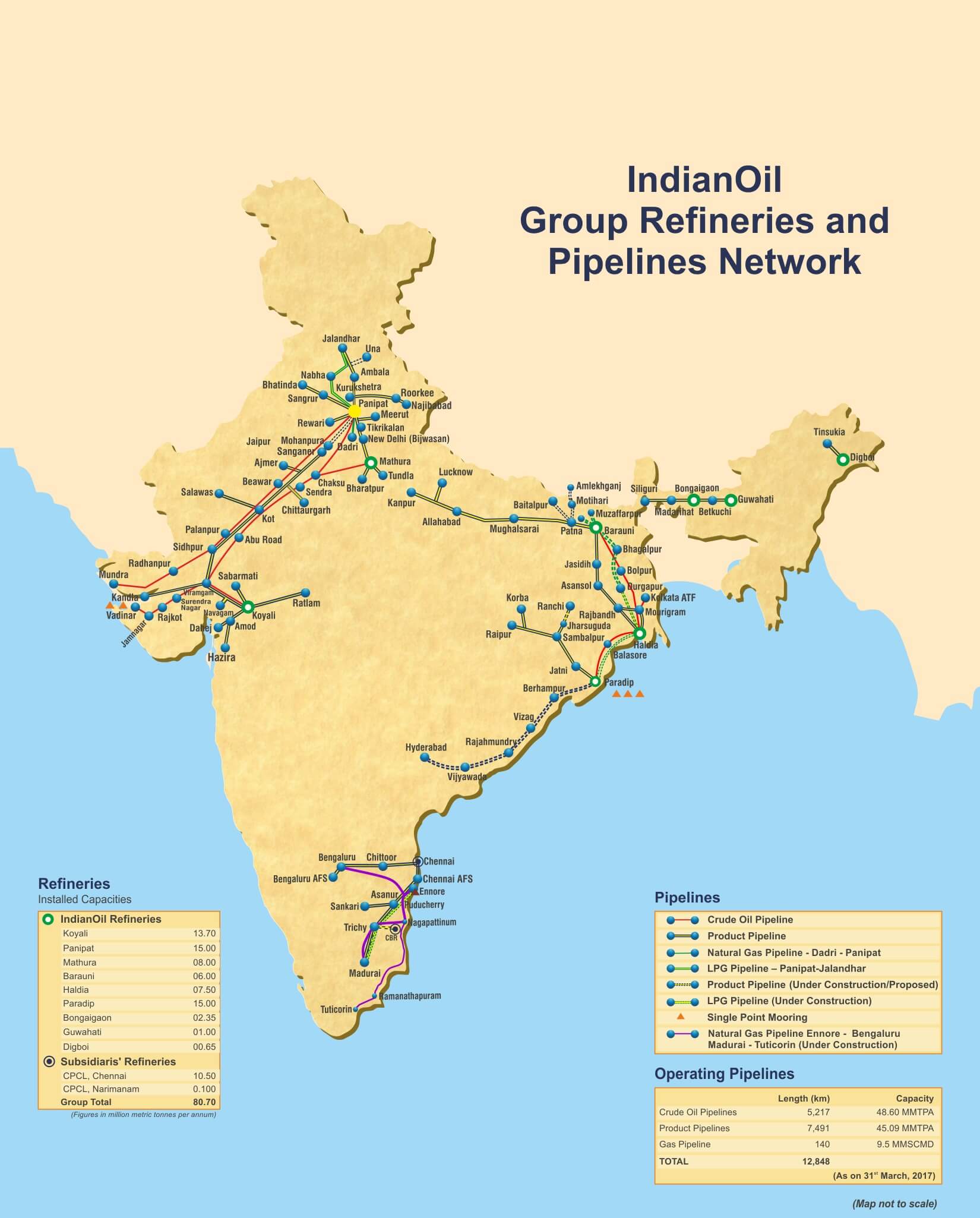
Indian Oil Corporation has approved an investment of ₹2,448.70 crore to develop a natural gas pipeline linking Kochi in Kerala with Thoothukudi in Tamil Nadu through Kanyakumari. The decision, disclosed on September 21, 2026, adds a major cross-state project to the company’s gas infrastructure plans in southern India.
The proposed line will run for 424.65 kilometres and is designed to move up to 6.84 million standard cubic metres of gas per day. Of that capacity, 1.71 million standard cubic metres per day is intended to be available on a common-carrier basis, allowing eligible third parties to use part of the network under applicable rules.
Indian Oil gas pipeline route and capacity
The Kochi–Kanyakumari–Thoothukudi pipeline would connect an important gas entry point on India’s south-west coast with industrial and demand centres farther south and east. Its route through Kanyakumari gives the project a cross-state role rather than limiting it to a single metropolitan or industrial cluster.
Indian Oil’s board approval establishes the sanctioned investment for development and operation of the project. The reports reviewed did not specify a commissioning date, construction schedule or individual customer commitments. Those details will matter in determining when the planned capacity becomes available and how quickly it is used.
The reported project cost is about ₹24.49 billion. Reuters converted that figure to approximately $255.6 million at prevailing exchange rates, while Indian Oil’s regulatory disclosure and Indian reporting expressed the approval as ₹2,448.70 crore.
Why the southern gas link matters
Gas pipelines can expand access beyond areas served directly by import terminals or producing fields. A link from Kochi toward southern Tamil Nadu could support deliveries to industrial users and other authorised customers along the route, subject to final network connections, contracts and regulatory arrangements.
The common-carrier allocation is also significant. It indicates that a defined share of the system’s capacity is planned for access by users other than the owner, which can broaden participation in the gas market when capacity is commissioned and booked.
The project fits India’s longer-term policy goal of increasing natural gas use as part of the country’s energy mix. Natural gas generally produces fewer local air pollutants and less carbon dioxide at combustion than coal or oil products, although it remains a fossil fuel and methane leakage can materially affect its climate footprint.
What comes next
Board approval is an important corporate milestone, but it is not the same as completion. The project will still require engineering, procurement, construction and the relevant statutory and regulatory clearances. Land access and coordination across Kerala and Tamil Nadu will also influence delivery.
Investors and potential users will therefore be watching for Indian Oil’s subsequent disclosures on the implementation timetable, contracting and capital expenditure. Until those details are released, the confirmed development is the approval of the ₹2,448.70-crore investment and the stated route, length and designed capacity.

